
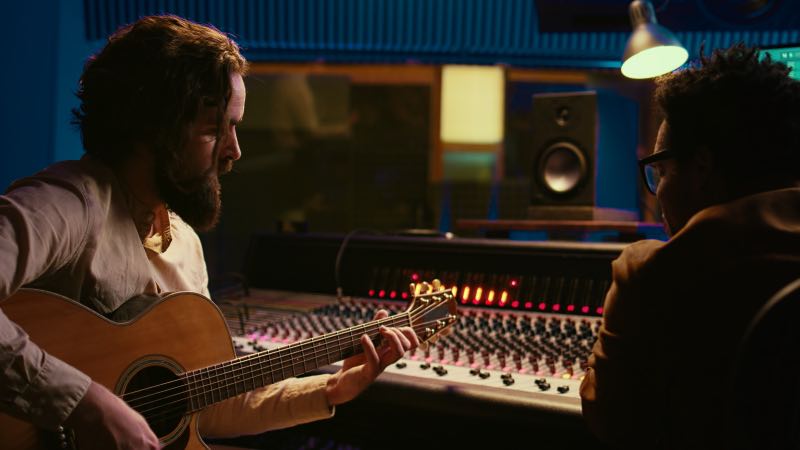
Sometimes it’s planned. You’ve been looking for someone whose writing complements yours, you’ve made the approach, you’ve booked the time. Sometimes it just happens — you know someone, the moment presents itself, a conversation turns into “we should try something.” Either way you end up in the same place: two people in a room and a blank page.
If you’re choosing deliberately, look beyond ability. Someone can be a strong musician and still be the wrong co-writer for you. How do they work? What do they bring? Do their instincts pull in a direction that interests you?
If it happened more organically, you probably already have a sense of this. You’ve seen how they think. You’ve had conversations that went somewhere. That’s worth something. Not every co-write needs to be a calculated match — some of the best ones started with nothing more than two people who trusted each other enough to try.
The only bad version is going in with no sense of whether you’re compatible and finding out three hours in.
Not a formal briefing. Just enough to know you’re pointed in the same direction. Do they need a hook first or do they start with feel? Do they write lyrics on the spot or come in with lines already? Are they precious about ideas or do they throw things away easily?
And agree — roughly — on what the song is before you go deep. What’s it about? What does it feel like? Who’s singing it and to whom?
It doesn’t have to be precise. But if one of you is writing a breakup song and the other is writing an anthem, you’ll feel it in every line and wonder why nothing’s landing. A shared direction at the start means the tension in the room goes toward the song, not toward each other.
A co-write means the song isn’t entirely yours. That’s the deal. Things you’d have kept, you might cut. Ideas you love might not survive the other person’s honest reaction.
That flexibility is what makes it work. A good co-write pulls both people somewhere neither would have gone alone.
But it helps to know — quietly, before you go in — what matters to you. Not as a line in the sand. Just so you know the difference between letting something go because it’s right for the song, and letting something go because you didn’t want the friction.
If the session goes well, there’s usually a point where it shifts. The arguing about a line stops feeling like arguing. The room gets a bit quieter. Something clicks into place and you both feel it at the same time.
That’s what you’re there for.
It doesn’t happen every time. Some sessions end with a decent draft and a polite goodbye. But when it does happen, it’s specific to that room, that day, those two people — and no version of writing alone gets you there.
The song you end up with wasn’t possible without the other person. That’s either the point, or it isn’t worth the session.